

Since the publication of the first TUM Sustainable Futures Report in 2024, TUM has continuously advanced its sustainability transformation. The focus has shifted from establishing governance structures to the systematic implementation, measurement, and continuous improvement of sustainable development.
The TUM Sustainable Futures Report 2026 highlights progress across the six fields of action of the TUM Sustainable Futures Strategy 2030. It presents key achievements, ongoing challenges, and priorities for the years ahead. The report covers the reporting period from 2023 to 2025.
With its TUM Sustainable Futures Strategy 2030, the Technical University of Munich aims to embed sustainability across all areas of the university and achieve climate neutrality. Developed jointly by students and staff, the strategy defines six fields of action and around 100 measures designed to systematically integrate sustainability into everyday university life. Key objectives include reducing greenhouse gas emissions, expanding sustainability-related research, and firmly embedding sustainability as a cross-cutting theme throughout the university.
The TUM Sustainable Futures Report serves as the central instrument for monitoring and evaluating progress toward these goals. It links strategic objectives with implemented measures and measurable indicators, thereby creating a transparent basis for accountability, institutional learning, and evidence-based decision-making. By continuously expanding data availability and further developing its reporting framework, TUM strengthens its ability to manage sustainability systematically and track progress over the long term.
The six fields of action of the Sustainable Futures Strategy 2030 provide the framework for TUM’s sustainable development. The following key figures highlight selected achievements from the reporting period 2023 to 2025.
Research

Sustainability is systematically embedded in research and innovation through interdisciplinary collaboration, responsible research practices, and strategic research priorities. By 2025, the share of Open Access publications had increased to 76%. Research activities also contribute to the United Nations Sustainable Development Goals (SDGs).
Education & Lifelong Learning

TUM offers 115 sustainability-related degree programs, including 37 bachelor's programs and 78 master's programs. Sustainability competencies are increasingly being integrated into academic programs and continuing education to equip students and professionals with the knowledge and skills needed to drive sustainable transformation.
Entrepreneurship & Innovation

In 2025, 58 TUM start-ups (30%) were classified as sustainability-oriented. Through UnternehmerTUM and the TUM Venture Labs, research results are translated into scalable innovations that address climate protection, the circular economy, and broader societal challenges.
Campus Operations

Scope 1 and Scope 2 greenhouse gas emissions decreased by 19.5% compared to 2021, while the share of renewable energy reached 45%. TUM installed 9,790 photovoltaic modules and expanded its reporting to include additional environmental indicators and emissions from commuter travel.
Governance & Community

The governance framework was further strengthened through the TUM Sustainability Office, Sustainability Board, the Green Offices, and university-wide engagement formats such as TUM Sustainability Day. In 2025, 24 newly appointed professors were classified as contributing to sustainability-related research and teaching.
Communication & Global Engagement
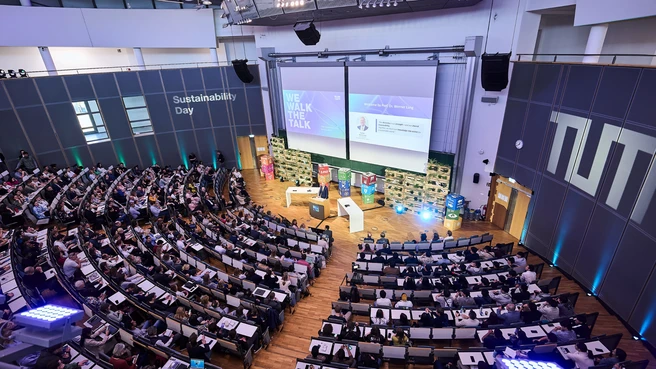
Strategic partnerships, international collaboration, and public engagement foster knowledge exchange beyond the university campus. In 2024 and 2025, TUM organized 68 public sustainability-related events in collaboration with partners from academia, industry, and society.
Compared to the first edition, the methodological foundation of sustainability reporting at TUM has been further refined and strengthened in this report.
Key enhancements:
Standardized processes for data collection
Refined accounting and reporting boundaries
New sustainability indicators
First-time reporting on emissions from commuter travel
Improved data quality and reduced reliance on estimates
Enhanced capabilities for performance monitoring and comparison over time
These developments strengthen TUM’s ability to systematically assess its sustainability performance, transparently track progress, and make informed decisions based on robust and reliable data.
TUM’s sustainability transformation is an ongoing process. In the coming years, the university will continue to implement its climate action plan, expand the use of renewable energy, further develop its sustainability reporting, and enhance the Sustainability Intelligence Platform. The aim is to manage sustainability measures in an increasingly data-driven manner and to assess their impact transparently and systematically.

Progress is measured through strategic objectives, implemented measures, and quantitative indicators across the six fields of action defined in the Sustainable Futures Strategy 2030. The report serves as the central instrument for monitoring progress and supporting evidence-based continuous improvement.
The TUM Sustainable Futures Strategy 2030 is TUM’s strategic framework for embedding sustainability across all areas of the university and advancing its development towards climate neutrality. The strategy defines six fields of action and approximately 100 measures that guide TUM’s sustainability activities.
Implementing the sustainability strategy is a shared responsibility across the entire TUM Community. Strategic responsibility lies with the Vice President Sustainable Transformation, Prof. Dr.-Ing. Werner Lang, while implementation is coordinated by the TUM Sustainability Office. As the university’s central coordinating body for sustainability, the Sustainability Office supports the implementation of the Sustainable Futures Strategy 2030, monitors progress on measures, and oversees sustainability reporting. TUM follows a holistic approach that integrates environmental, economic, and social dimensions of sustainability. Together with students, staff, and national and international partners, the university actively promotes sustainable transformation both within the institution and beyond.